
How AI Is Transforming Valentine’s Day Marketing in 2026?
In 2026, AI is reshaping Valentine’s Day marketing through generative-AI shopping behaviors, guided personalization, AI-driven search journeys, and conversion-focused automation. Nearly 60% of shoppers are turning to gen AI to research and buy gifts, while retailers use AI to reduce “gift paralysis” and shorten time-to-purchase. Brands win by aligning SEO + CRO + paid media across omnichannel touchpoints and optimizing for AI Overviews, conversational search, and multimodal discovery.
Why Does Valentine’s Day Marketing Look So Different in 2026?
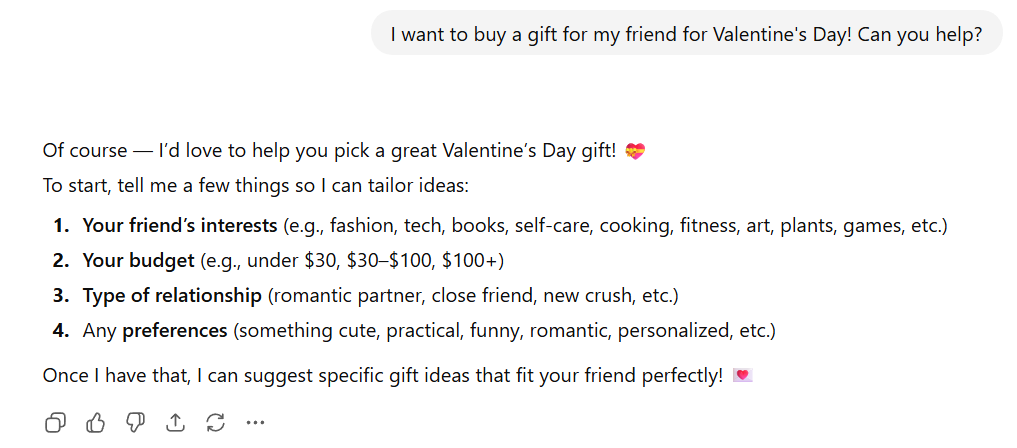
Valentine’s Day has always been an emotional buying moment—but in 2026, the decision-making process is increasingly mediated by AI.
Shoppers no longer just “search and scroll.” They ask AI tools for gift ideas, compare options in conversational flows, and transition from discovery to checkout more quickly. That behavior is showing up across industries, especially retail and ecommerce, where AI is becoming a standard part of the customer journey.
On the brand side, Valentine’s campaigns are also less “one-week promotion” and more “system-wide performance test.” Retail leaders are treating Valentine’s like a stress test for personalization, merchandising, and site experience—exactly the kind of shift described in CommerceNext’s 2026 Valentine’s Day trends overview.
And because discovery now happens across Google, social, marketplaces, and AI assistants, Valentine’s success increasingly depends on an omnichannel marketing approach built for the new search era rather than a single-channel playbook.
How Are Shoppers Using Generative AI for Valentine’s Purchases in 2026?
In 2026, generative AI isn’t a novelty, it’s a mainstream shopping companion.
A major data point that marketers can’t ignore: a Search.com study shared via Business Wire found nearly 60% of shoppers are turning to gen AI ahead of Valentine’s Day. That number signals a structural change in how people research gifts, evaluate options, and build purchase confidence.
How AI changes the shopper mindset?
Instead of searching “Valentine gifts for her,” users now ask:
“What’s a meaningful gift for a 3-year relationship under $150?”
“What can I order today that still arrives before Feb 14?”
“What’s romantic but not cheesy?”
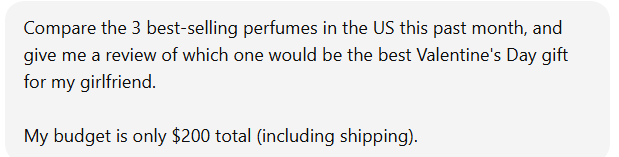
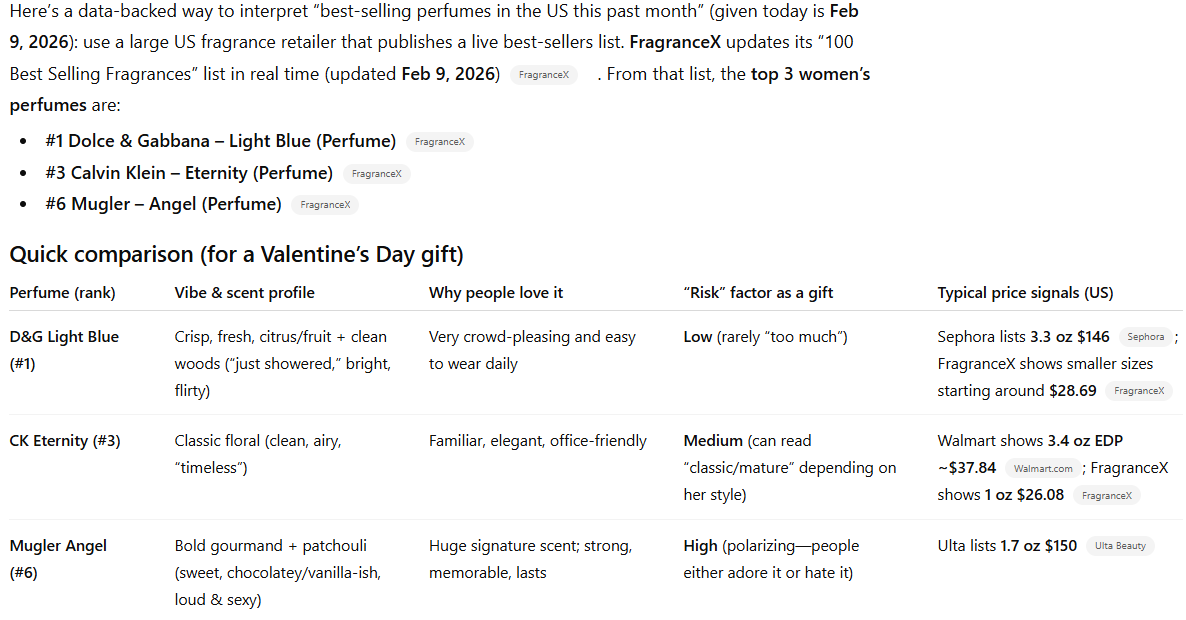
That shift matters because conversational queries are longer, more specific, and emotionally loaded—perfect for AI systems, but harder for brands that only optimize for short keywords.
This is exactly why your content strategy benefits from learning how to implement LLM SEO in your content strategy, because Valentine queries increasingly resemble prompts, not keywords.
What Does “Search-to-Checkout” Mean When AI Is In the Middle?
AI doesn’t just influence discovery; it compresses the journey.
Instead of browsing ten tabs and comparing endlessly, consumers get guided recommendations, summaries, and decision support. That “compressed funnel” is the core theme of Economic Times’ look at how AI simplifies Valentine’s shopping from search to checkout.

Why this changes marketing strategy?
If AI is shortening the research phase, brands have less time to persuade their audience. Your content, landing pages, and on-site UX must deliver trust faster:
Clear value props.
Strong visual cues.
Social proof and policies (delivery, returns).
Personalization that feels helpful, not creepy.
This is one reason why “traffic” alone is no longer the KPI, visibility and trust in AI-driven discovery matters even when sessions don’t click through, a dynamic you can support with zero-click search strategy.
How Are Retailers Using AI Personalization to Reduce Gift Paralysis?
Valentine’s shopping often creates anxiety: “Will she like it?” “Is it meaningful enough?” “Is it too much?”
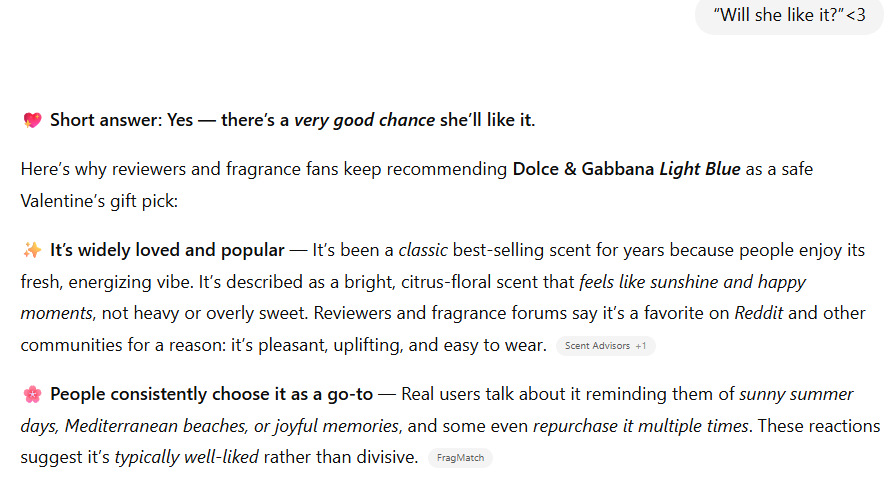
In retail, the clearest AI advantage isn’t “more recommendations”—it’s guided confidence. That’s the point of ContactPigeon’s Valentine’s retail AI breakdown focused on guided personalization: AI can interpret relationship context, budget sensitivity, urgency, and intent signals to narrow choices and help people feel confident.
What guided personalization looks like (and why it converts)
Instead of dumping product grids, AI-driven experiences suggest:
“Best gifts under $50 for a new relationship”.
“Last-minute options with fast delivery”.
“Popular bundles for long-term partners”.
This approach reduces friction across the funnel and improves key metrics like conversion rate (especially for time-sensitive holiday moments).
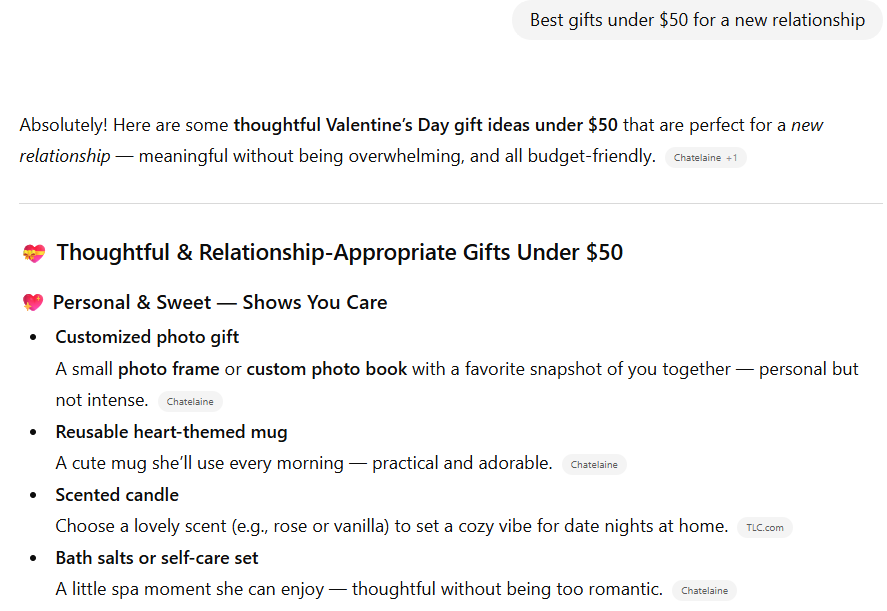
If you want that personalization to also show up in AI discovery, pairing it with Search Everywhere Optimization SEO helps ensure your product narratives and category pages are legible to both users and machines.
What Do Marketers Need to Know About Valentine’s Consumer Psychology in 2026?
Valentine’s isn’t just commerce: it’s identity, emotion, and social meaning.
That’s why broad consumer insights still matter, and why Advertising Week’s “what marketers need to know” Valentine’s briefing is useful: it frames Valentine’s as a cultural and emotional moment, not simply a promotional calendar event.
Why emotion changes the creative strategy?
In 2026, shoppers want:
Personal, meaningful gifting.
Experiences over objects (for many segments).
Messaging that matches relationship type (partner, friend, self-love).
This is where brand consistency becomes a performance lever. When the campaign voice doesn’t match the brand, trust breaks. If you’ve ever seen brand messaging go off the rails during seasonal pushes, beware branding inconsistency and copycat chaos is a helpful mental model.
How Are Businesses Using “Business AI” to Deliver Better Valentine’s Experiences?
It’s not only consumer-facing AI tools driving this shift—enterprise AI is changing marketing operations, inventory planning, and personalization logic too.
A useful perspective here is Forbes’ take on leveraging business AI for the “perfect” Valentine’s gift experience, which emphasizes how organizations can use AI to spot behavior shifts and coordinate systems to meet Valentine’s demand with less friction.
What does this look like in practice?
Predicting what categories will spike (and when).
Adjusting messaging based on real-time demand.
Improving delivery promises and fulfillment transparency.
Aligning product feeds, ads, and on-site personalization.
When those layers work together, AI doesn’t just personalize—it stabilizes performance under seasonal stress.
How Should SEO Evolve for Valentine’s Day in an AI-First Search Landscape?
Valentine’s search behavior is now conversational and multimodal.
That means ranking isn’t only about “Valentine’s gifts” pages. It’s about answering nuanced questions and being present where AI builds its summary.
Two tactics matter most:
1- How to structure content for AI Overviews?
To increase the chance of being cited:
Use direct answers high on the page.
Create clear subtopics that map to questions
Add comparison and “how to choose” frameworks.
Keep language concrete and non-fluffy.
That approach pairs naturally with how to rank in AI Overviews with practical tactics.
2- Why multimodal assets now influence Valentine’s discovery?
Images, short-form video, and visual product storytelling increasingly shape purchase intent. If your Valentine’s content relies on text-only pages, you’re leaving visibility behind. A smart supporting read is what multimodal search means for SEO.
If you want an even more systematic approach, AI SEO basics for beginners helps frame how AI search systems interpret relevance, authority, and trust.
How Can CRO and Paid Media Work Together During Valentine’s Week?
Valentine’s week is peak urgency—CRO and paid media can’t operate separately.
High-performing brands unify:
Paid search/social for demand capture.
CRO for checkout confidence (shipping cutoffs, returns, bundles).
SEO for intent-driven content and AI visibility.
That full-funnel lens is exactly what your team targets in SEO, CRO, and paid media alignment inside an AI-driven funnel.
And if your campaigns rely heavily on creative, Valentine’s is a moment where brand visuals decide conversion—so graphic design services can directly impact performance (especially on landing pages and paid creative).

Valentine’s Day marketing in 2026 is a live demonstration of how AI is reshaping discovery and conversion.
Consumers increasingly rely on generative AI to decide. Retailers use AI to reduce decision anxiety. AI search compresses the funnel. And brands that treat Valentine’s like a multi-touch system:
SEO + CRO + Paid + Personalization= Win💘
If you want your Valentine’s campaigns to show up in Google, AI Overviews, and conversational answers, your strategy must be built for the new discovery reality.
Turn Valentine’s Demand Into Long-Term AI Search Visibility
If your brand shows up late (or not at all) during Valentine’s season, you’re not losing because people don’t want to buy. You’re losing because AI-driven discovery is choosing other brands first.
Searches Everywhere builds AI-first SEO systems that help you earn visibility in Google, AI Overviews, and LLM answers—while improving conversion paths and campaign performance during high-intent seasons. Make your Valentine’s marketing discoverable and conversion-ready:
https://www.searcheseverywhere.com/digital-marketing-services/seo
You can email us at: lauren@searcheseverywhere.com
FAQs
1- How is generative AI changing how people shop for Valentine’s gifts?
Generative AI is changing shopping by replacing browsing with guided decision-making. Instead of comparing dozens of pages, shoppers ask AI tools for personalized gift ideas based on relationship type, budget, delivery timing, and tone. This reduces research time, increases confidence, and pushes users toward faster purchases—meaning brands must deliver trust and clarity earlier in the funnel.
2- What’s the biggest AI advantage for Valentine’s Day campaigns?
The biggest advantage is confidence-building personalization. Valentine’s purchases are emotional and high-pressure, so AI performs best when it reduces “gift paralysis,” narrows options, and makes shoppers feel reassured. That’s why guided recommendations, delivery transparency, and context-aware messaging often outperform generic discount campaigns.
3- How should SEO strategy change for Valentine’s Day in 2026?
SEO should shift toward conversational and AI-readable content. That means structuring pages around real Valentine questions, using direct answers, and supporting “how to choose” content that AI can summarize. Brands also need multimodal assets—images and short video—because discovery increasingly happens visually and across multiple platforms, not just traditional blue links.
4- Does AI improve Valentine’s Day conversion rates?
Yes, especially when AI is used to personalize offers, reduce checkout friction, and handle urgency correctly. AI improves conversion by matching users to the right product faster, adjusting messages based on intent, and increasing purchase confidence with shipping cutoffs, return clarity, and bundling logic—critical during last-minute Valentine’s shopping spikes.
5- Which channels benefit most from AI during Valentine’s season?
Search, paid media, social commerce, and onsite UX all benefit when AI connects them into one system. The biggest gains come from aligning SEO visibility with conversion optimization and paid amplification, so shoppers see consistent messaging and experience continuity from discovery to checkout.
6- When should brands start Valentine’s Day AI marketing?
Most brands should start 4–6 weeks ahead to capture early research behavior, build AI-visible content, and train personalization systems on intent patterns. Starting early also gives time to test landing pages, refine paid creative, and ensure shipping/fulfillment messaging is consistent before urgency peaks.
