
How AI Can Help With Local SEO: 4 Ways
AI tools help local businesses uncover long-tail, location-specific keywords that reflect real buying intent, not just generic search volume.
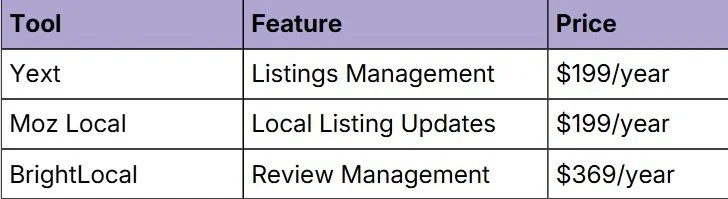
A well-optimized Google Business Profile, paired with AI-assisted review responses and platforms like Yext, Moz Local, or BrightLocal, signals trustworthiness to both Google and AI recommendation engines.
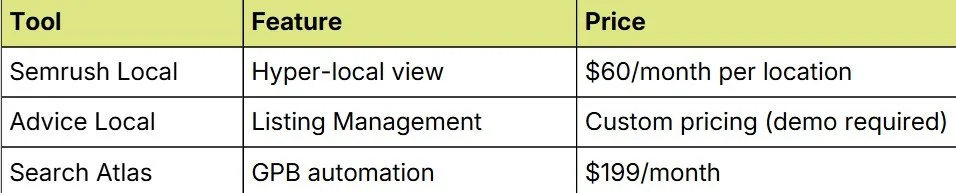
AI can automate citation audits and NAP consistency checks across hundreds of directories using tools like Search Atlas Advice Local, and BrightLocal, one of the strongest trust signals for both traditional rankings and LLM recommendations.
Hyperlocal, AI-personalized content: blog posts, landing pages, and neighborhood guides, helps brands get cited by AI Overviews and chatbots, not just rank in the 10 blue links.
Machine learning continuously analyzes relevance, distance, and prominence (the three core local ranking signals) to keep visibility consistent as search behavior shifts.
Being visible in Google isn't the same as being recommended by ChatGPT, Gemini, or Perplexity, local businesses now need to optimize for both.
How AI Is Rewriting the Rules of Local Search
If you've searched for a "plumber near me" or "best tacos downtown" lately, there's a good chance you didn't scroll through ten blue links to find your answer, you got a summarized recommendation instead. That shift is at the heart of why local SEO looks so different than it did even two years ago, and it's exactly why so many small business owners are asking how AI can help with local SEO in the first place.
The good news: AI isn't dismantling the fundamentals of local search, it's amplifying them. Businesses that used to spend hours manually researching keywords, updating directory listings, and responding to reviews can now hand much of that heavy lifting to AI-powered tools, freeing up time to focus on strategy and customer experience. Community discussions among practitioners, including an active conversation among local SEO professionals swapping notes on what's actually moving the needle, reflect a similar consensus: AI speeds up the busywork, but it doesn't replace strategic thinking.
Below are four practical, 4 proven ways AI can strengthen your local SEO (along with the specific tools, ranking signals, and emerging trends behind each one( to help your business get found on Google, show up in AI Overviews, and get cited directly by tools like ChatGPT and Gemini.
1. AI Can Uncover High-Intent, Long-Tail Local Keywords
Find the searches your competitors are missing
Generic keywords like "auto repair" or "hair salon" are crowded and expensive to rank for. Long-tail, location-specific phrases — think "24-hour emergency auto repair near Michigan Avenue" or "affordable brake repair shops in Brooklyn" — carry far less competition and much stronger buying intent. AI-powered keyword research tools can surface these hyper-specific variations at scale, something that would take a human researcher days to compile manually. Effective content built on this research should also target clearly defined phrases such as "AI Google Business Profile," "AI Local SEO," and "local SEO automation," which reflect exactly how both searchers and AI systems categorize this topic.
Match content to local search intent
Beyond keywords, AI tools can categorize local queries by intent — commercial, informational, or navigational — so your content strategy actually mirrors how nearby customers search. This kind of intent mapping is a foundational piece of any modern strategy, and it pairs well with a broader omnichannel approach to ranking across Google, TikTok, and AI search.
Expert Insight: Long-tail, location-specific phrases make up the vast majority of search queries, and they convert at a noticeably higher rate than broad, generic terms. Local businesses that ignore this segment are leaving easy visibility — and easy revenue — on the table.
2. AI Can Automate and Strengthen Your Google Business Profile
Your Google Business Profile (GBP) is arguably the single most important local SEO asset you own, yet it's the one most businesses neglect after the initial setup. AI now plays a direct role in automating that upkeep — updating information, responding to inquiries, and analyzing performance data so your profile stays accurate with minimal manual effort. Since accurate listings create a smoother user experience, this consistency also tends to translate into more foot traffic and stronger customer engagement.
Write sharper GBP descriptions and posts
AI writing assistants can generate optimized, customer-focused GBP descriptions and posts that reflect real local search intent — without eating up your afternoon. As detailed in one breakdown of four AI-driven local SEO tactics that actually move rankings, pairing strong profile content with consistent posting activity is one of the clearest signals of an active, trustworthy business.
Why automating GBP updates pays off
Automating profile management delivers three clear advantages: speed, since AI tools can process and publish updates almost instantly; fewer errors, because automation removes the human mistakes that can mislead potential customers; and stronger rankings, since consistent, accurate information is one of the clearest trust signals Google rewards.
Manage reviews at scale
Responding to reviews tells both customers and search algorithms that your business is engaged. AI-powered reputation tools can flag urgent feedback, draft on-brand responses, and monitor multiple platforms simultaneously — a workflow that's nearly impossible to sustain manually once your review volume grows. AI also enhances reputation management by analyzing sentiment patterns across reviews, helping you spot service issues early and respond proactively rather than reactively. Review quality and response rate are now weighted even more heavily by AI recommendation engines than by traditional local rankings, since large language models often use review sentiment as a proxy for real-world trust.
Expert Insight: AI recommendation engines increasingly treat review volume, rating, and response speed as trust signals in their own right — a business with a strong Google star rating but a poor response rate may quietly lose ground to a more responsive competitor with a slightly lower rating.
3. AI Can Automate Citation Management and NAP Consistency
Keep your business data accurate everywhere it appears
Name, address, and phone number (NAP) consistency across directories has always mattered for local SEO — but it matters even more now, since AI models pull from multiple listings, review platforms, and maps data to decide who to recommend. Accurate citations don't just improve credibility with customers; they directly reinforce search rankings, while consistent reputation management builds long-term loyalty. Manually auditing hundreds of directories isn't realistic for most business owners, which is why AI-enhanced citation tools are becoming standard practice.
Prioritize quality over quantity
Modern AI tools don't just sync listings — they identify which directories actually influence rankings and AI visibility for your specific category and location, then flag mismatches before they hurt trust. This kind of entity-level consistency is increasingly central to how brands get recognized by AI search systems, since large language models are essentially trying to confirm that your business is who it says it is, everywhere it appears online.
4. AI Can Scale Hyperlocal, Personalized Content
Generate location-specific content ideas
AI content tools can quickly generate hyperlocal blog topics — neighborhood guides, seasonal checklists, community event recaps — tailored to a specific city, ZIP code, or even a single street. Using natural language processing, these tools can produce high-quality, keyword-targeted articles far faster than a traditional content workflow, without sacrificing the specificity that makes local content actually useful. This kind of specificity is what separates content that ranks and gets cited from content that gets ignored. A practical guide to AI SEO for local businesses notes that AI recommendation engines are considerably more selective than traditional search, meaning generic, templated content is far less likely to earn a citation from ChatGPT or Gemini than genuinely localized material.
Personalize messaging for different neighborhoods
AI can also help tailor tone and messaging based on the character of a specific area — more creative language for an arts district, more professional language for a business hub — based on real local search behavior and community interests. This deeper level of personalization connects directly to how AI search is reshaping both local SEO and personal branding for owner-operated and service-based businesses in particular.
Expert Insight:AI Overviews and chatbot answers tend to favor content with clear structure, specific local details, and genuine expertise over generic, keyword-stuffed copy. If you want your brand mentioned directly in AI-generated answers, specificity is non-negotiable.
There's also broad discussion around how AI Overviews are reshaping local search visibility for small businesses in 2026, with many business owners noting that ranking well in Google no longer guarantees a mention in an AI-generated summary — which is exactly why all four tactics above need to work together.
How Machine Learning Keeps Local Rankings Consistent
Machine learning sits quietly behind all four tactics above, continuously analyzing large volumes of search and behavior data to find patterns that inform better optimization decisions. Specifically, it evaluates the three core local ranking signals:
Relevance: how well your business matches the intent behind a given local search.
Distance: the geographic proximity between the searcher and your business.
Prominence: how well-known and trusted your business is within its local area, based on signals like reviews, links, and citations.
Because machine learning adapts as search behavior evolves, it also helps maintain ranking consistency over time. Rather than reacting after a ranking drop, these systems identify successful patterns early and adjust strategy proactively, which builds long-term user trust and rewards businesses that stay aligned with shifting local search trends. This is one reason tracking and measuring AI SEO success has become just as important as the optimization work itself.
What's Next: Emerging AI Trends in Local SEO
Local SEO is continuing to evolve alongside AI, and a few trends are worth watching closely:
Conversational AI and voice-driven local search
Conversational AI — voice assistants and chatbots — is changing how customers interact with local businesses, enabling instant responses to inquiries and a smoother overall experience. As more searches happen through voice and chat rather than typed queries, optimizing for natural, conversational phrasing is becoming as important as optimizing for traditional keywords, a shift explored further in how AI is reshaping SEO opportunities for brands.
The measurable impact of AI adoption
Early case studies back this up: businesses using AI-driven content generation have reported meaningful increases in organic traffic within three to six months of implementation — a timeline that lines up closely with what most local businesses can realistically expect from a well-executed AI SEO strategy.
Expert Insight: Personalization and predictive analytics are quickly becoming the baseline, not the differentiator, in local search. Businesses that adopt these capabilities early are positioning themselves to stay ahead as AI-driven discovery keeps expanding beyond the traditional search results page.
FAQs
1. Is AI actually replacing traditional local SEO?
No. AI is amplifying the fundamentals of local SEO — accurate business data, strong reviews, relevant content, and consistent listings — rather than replacing them. The businesses seeing the best results are using AI to execute these fundamentals faster and more consistently, not skipping them altogether.
2. Will AI Overviews hurt my website traffic?
It's possible, since AI-generated summaries can reduce click-through rates on traditional listings. However, this also creates a new opportunity: if your business is cited directly inside an AI Overview or chatbot answer, you gain visibility even without a click, which can still drive brand awareness, calls, and direct visits.
3. What's the fastest way to start using AI for local SEO?
Start with your Google Business Profile. Use AI to draft sharper descriptions and posts, then move on to auditing your NAP consistency across major directories using tools like BrightLocal or Synup, since both of these areas offer quick, measurable wins.
4. Do I need to hire an agency, or can I do this myself?
Small businesses can absolutely start with free or low-cost AI tools. However, managing citation audits, hyperlocal content calendars, and AI visibility tracking across multiple platforms becomes time-consuming quickly, which is why many growing businesses eventually bring in specialized help.
5. How does AI decide which local businesses to recommend?
AI recommendation engines typically weigh data accuracy across listings, review ratings and response rates, and cross-platform consistency more heavily than traditional search algorithms do. A business with excellent reviews but inconsistent NAP data across directories may still lose visibility to a more consistent competitor.
6. How long does it take to see results from AI-assisted local SEO?
Most businesses see measurable movement within three to six months, though this depends heavily on your starting point — a business with a neglected Google Business Profile and messy citations will typically take longer to see results than one that's simply optimizing an already-solid foundation.
Ready to Turn AI Into Your Local SEO Advantage?
Local SEO in 2026 isn't just about ranking — it's about being represented accurately and consistently everywhere AI systems look for answers. If you'd rather focus on running your business than auditing directory listings and comparing tool subscriptions, our team at Brand Searches Everywhere can help.
We offer full Search Everywhere Optimization (SEO) services built for both traditional rankings and AI visibility, branding strategy services to make sure your business shows up consistently everywhere, paid advertising to fill visibility gaps while your organic strategy builds, and graphic design services to keep your local presence looking as polished as it performs.
Ready to get started? Reach out to our team at lauren@searcheseverywhere.com or seo@searcheseverywhere.com to request a custom local SEO strategy for your business.
