The Essential SEO & AI Search Checklist: 45 Steps to Optimize Your Site for Google and AI Search
The most practical way to understand SEO in 2026 is this: first, remove everything that prevents a website from being found, crawled, understood and trusted. Growth comes after that.
For years, SEO was reduced to keywords, content and backlinks. That definition is no longer enough. A brand also needs to know whether it appears in AI Overviews, AI Mode, Copilot, ChatGPT, zero-click results, videos, images and the social platforms people use before making a decision.
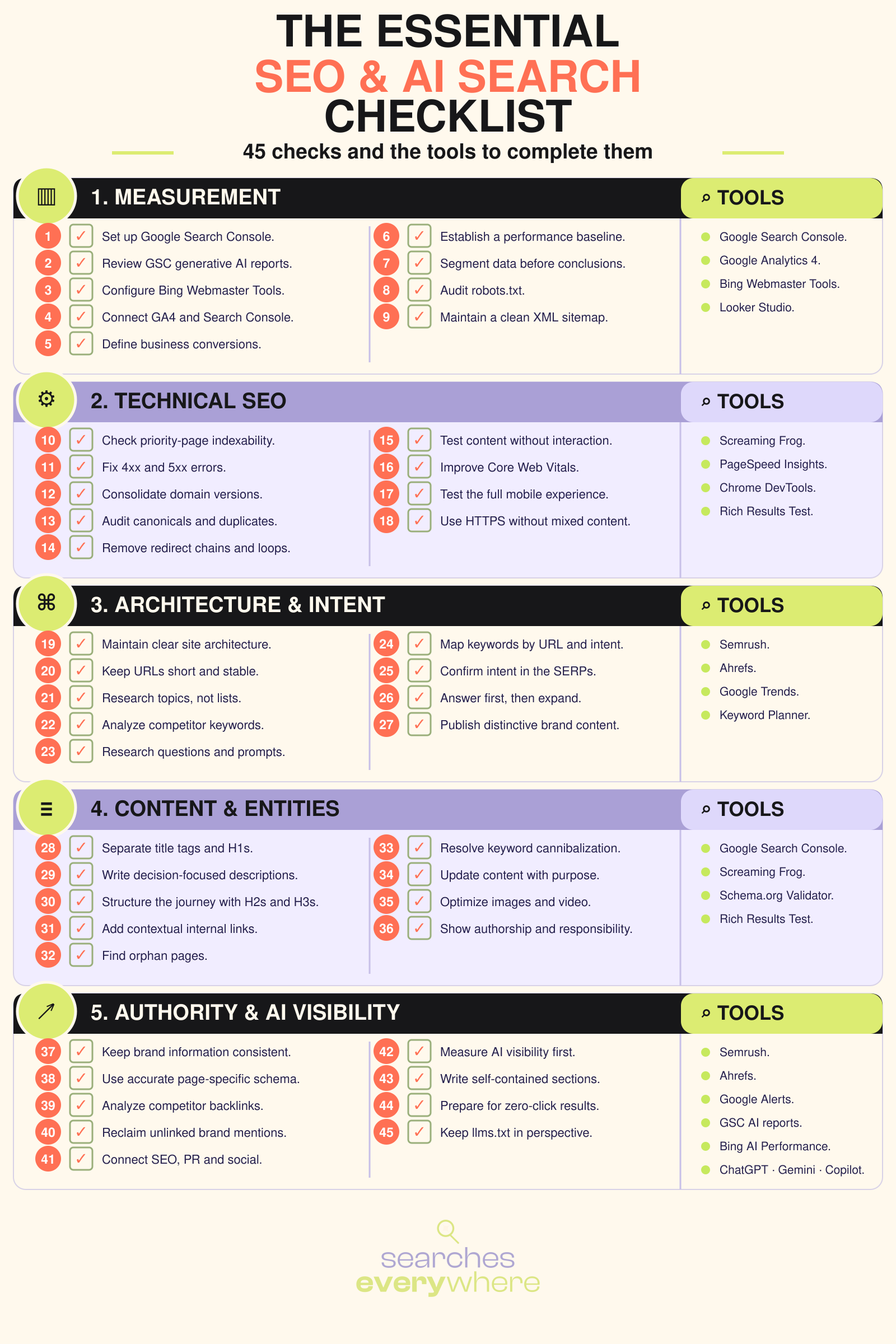
That does not mean abandoning traditional SEO to chase every new development. It means strengthening the foundation and measuring more of the discovery journey. This checklist covers 45 areas in the order they should be addressed: measurement, technical SEO, intent, content, authority and visibility in AI-powered search.
What to Prioritize Before You Begin?
Set up measurement before changing the website.
Confirm that priority pages can be crawled, rendered and indexed.
Fix technical blockers before producing more content.
Research topics, intent, questions and prompts—not isolated keywords alone.
Answer first and expand afterward.
Connect content, brand, authority and experience.
Measure conversions, mentions and citations, not only rankings and traffic.
Use AI to accelerate analysis and execution, never to replace verification or editorial judgment.
How Do You Use This SEO Checklist Without Creating an Endless To-Do List?
Not every page deserves the same level of attention. Begin with the pages that support the business: the homepage, services, products, categories, locations, forms, booking pages and content that already receives impressions or backlinks.
Then classify each finding:
Critical: Prevents crawling, indexing, access or conversion.
High: Affects a priority page, qualified traffic or revenue.
Medium: Limits clarity, authority or growth potential.
Low: Improves presentation or consistency but does not block performance.
Finally, turn every finding into a task that can be verified. “Optimize the website” is not a task. “Fix the canonicals on 25 service pages and validate them in Search Console” is.
Foundations and Measurement: Are You Seeing What Is Actually Happening?
1. Configure Google Search Console Correctly.
Verify the necessary properties and review performance, indexing, sitemaps, Core Web Vitals, manual actions and enhancement reports.
Search Console shows what happens before the visit: queries, pages, countries, devices, impressions, clicks, CTR and average position. Without that information, it is easy to make decisions based on assumptions rather than evidence.
2. Review the Generative AI Report in Search Console.
Search Console now provides a dedicated view for analyzing URL impressions within Google Search generative features, including AI Overviews and AI Mode, as well as generative experiences in Discover.
The report lets you review pages, countries, devices and performance over time. It does not replace the standard Performance report. It adds a specific view of visibility within generative search experiences.
3. Configure Bing WebmasterTools and AI Performance.
Bing Webmaster Tools remains useful for reviewing indexing and organic performance. Its AI Performance report adds cited pages, grounding queries and citation trends across Copilot, Bing-generated summaries and selected partner integrations.
One distinction matters here: a citation is not a ranking position or a click. It is a signal that the content was used as a source and should be evaluated alongside traffic, conversions and brand visibility.
4. Connect GA4 with Google Search Console.
Search Console explains how the user arrived. GA4 shows what happened afterward. Together, they help distinguish a visibility problem from an experience or conversion problem.
A common example: a page earns many impressions but few clicks. Review intent, the title tag and the snippet. If the page receives visits but produces no action, the issue is more likely to involve the content, CTA, offer or customer journey.
5. Define Conversions That Matter to the Business.
Not every visit has the same value. Configure events for forms, calls, bookings, purchases, downloads, quote requests and any action that moves a user closer to a decision.
The goal is not more traffic for the sake of traffic. The goal is to attract qualified demand and convert it.
6. Establish a Baseline Before Making Changes.
Record at least:
Organic clicks and impressions.
Priority keywords and pages.
Organic conversions and revenue.
Indexed and excluded URLs.
Core Web Vitals.
Referring domains.
Brand mentions.
Citations and Share of Voice across AI systems.
Without a baseline, every increase looks like a success and every decline looks like a penalty. Compare equivalent periods and account for seasonality, campaigns and internal website changes.
7. Segment Before Drawing Conclusions.
Averages hide problems. An overall decline may come entirely from mobile, one location, one page group or non-branded queries.
Segment by country, device, intent, directory, template and page type. Only then decide what changed and where action is required.
Insight: A dashboard is not a strategy. Data becomes useful when it helps determine which page to fix, which content to update and which channel to strengthen.
Technical SEO: Can Google and Other Systems Process the Website?
8. Review the Robots.txt File.
Confirm that the file exists, responds correctly and does not accidentally block important pages, scripts or resources. Include the sitemap location when the platform allows it.
Also review the policy applied to AI crawlers. Having no rules does not equal having an open strategy. It means accepting the default behavior without distinguishing between search crawlers, training bots and scrapers.
9. Maintain a Clean Sitemap XML file.
The sitemap should contain canonical, indexable URLs that return a 200 status. Exclude redirects, errors, duplicates and noindex pages.
Submit it to Search Console and Bing Webmaster Tools. A sitemap supports discovery, but it does not require any search engine to index a URL.
10. Check the Indexability of Priority Pages.
Review noindex directives, meta robots tags, X-Robots-Tag headers, canonicals, status codes and robots.txt blocks. Use URL Inspection to compare the published page with the version Google can process.
It is not enough for a URL to load in a browser. It must also be accessible, renderable, canonical and eligible for indexing.
11. Fix 4xx and 5xx Errors With Context.
Update broken links, restore content when it still has value and redirect only to a relevant alternative.
Sending every 404 to the homepage does not solve the problem. It can create soft 404s and, more importantly, send visitors to a page that does not answer their request. Treat 5xx errors with greater urgency because they indicate server failures.
12. Consolidate Domain Versions.
The http, https, www and non-www versions should redirect to one primary version.
Then confirm that canonicals, sitemaps, internal links and structured data use the same version. Technical consistency prevents important signals from being divided.
13. Audit Canonicals and Duplicate Content.
Every indexable page should identify its primary version. Review filters, parameters, pagination, printable versions, repeated categories and URLs generated by the CMS.
A canonical is a signal, not an order, and it cannot repair a poorly planned site architecture. It should align with the sitemap, internal links and redirects.
14. Remove Redirect Chains, Loops and Unnecessary Hops.
Update links so they point directly to the final destination. A chain adds latency and crawl steps; a loop prevents the destination from loading at all.
Use 301 or 308 for permanent changes. Reserve 302 or 307 for situations that are genuinely temporary.
15. Confirm What Content Exists Without Requiring an Interaction.
Google can process JavaScript, but that does not mean every crawler or agent will handle it in the same way. Compare the page source, rendered DOM and the version inspected by Google.
Essential copy, links, products, prices and CTAs should remain accessible without requiring an interaction that some systems may not execute.
16. Improve Core Web Vitals Without Chasing a Perfect 100.
Review:
LCP: How quickly the main content loads.
INP: How quickly the page responds after an interaction.
CLS: How visually stable the page remains while loading.
Compress images, reduce unnecessary JavaScript, defer non-critical scripts and control third-party widgets. The goal is not a screenshot with a perfect score. It is to remove friction that affects real users and conversions.
17. Test the Complete Mobile Experience.
Do not stop after confirming that the design “looks fine.” Test navigation, buttons, filters, forms, pop-ups, tables, checkout and readability without zooming or horizontal scrolling.
Google uses the mobile version of content for indexing and ranking. If mobile hides important information or links, the problem extends beyond UX.
18. Use HTTPS Without Mixed Content.
Check the certificate, insecure resources and internal links that still point to HTTP. Updating them prevents warnings, unnecessary redirects and trust issues.
19. Maintain a Clear Site Architecture.
Priority pages should be accessible through navigation, topical hubs and contextual links. Three clicks can be a helpful benchmark, but it is not a rigid rule.
What matters is whether the architecture reflects which services, products and topics are strategically important to the business.
20. Keep URLs Short, Descriptive and Stable.
Use readable words separated by hyphens. Avoid session IDs, unnecessary parameters and slug changes without a clear reason.
A URL does not need to contain every possible keyword. It should explain the topic and, most importantly, remain stable.
For a deeper review, use our technical SEO and AI search audit checklist.
Keywords, Intent and Content: Does the Page Solve the Search?
21. Research Topics, Not Isolated Lists.
Begin with real problems, products, services and decisions. Then group related keywords by meaning and intent.
One page can rank for multiple variations when they reflect the same need. Splitting them unnecessarily often produces thin content and cannibalization.
22. Analyze Competitor Keywords Without Copying Their Strategy.
A keyword gap is not a shopping list. Filter “missing” and “weak” opportunities based on relevance, intent and commercial value.
Not every competitor keyword belongs in your strategy. Prioritize queries for which the business has a real audience, a real solution and a page capable of providing a better answer.
23. Research Conversational Questions and Prompts.
People Also Ask, Reddit, forums, reviews, sales calls and support conversations show how the audience speaks before it learns the industry terminology.
Test complete questions in search engines and AI assistants as well. The purpose is not to copy the response. It is to identify subtopics, sources, formats and objections the content should address.
24. Create a Keyword Map by URL and Intent.
Assign each page a primary topic, semantic variations, related questions and an intent. The map helps identify gaps, pages that are too similar and genuine cannibalization issues.
Do not create a new URL for every minor variation. If users expect one integrated answer, the content should be integrated as well.
25. Confirm Intent Directly in the SERPs.
Search the query and review what Google displays: articles, categories, products, videos, tools, local results or comparisons.
If most results are transactional, an informational article is unlikely to compete. The format needs to support what the user is trying to accomplish.
26. Answer First and Expand Afterward
Define the concept or answer the question in the opening lines. Then add examples, data, context and exceptions.
Answer-first content does not mean shallow content. It means not forcing readers through five paragraphs before giving them the main point.
27. Publish Content That Could Not Belong to Any Brand.
Add methodology, experience, proprietary data, well-supported opinions, real examples and useful comparisons. If the company name can be replaced with any competitor without changing the article, the content still lacks original value.
Publishing more does not compensate for publishing the same information. Generic content may fill an editorial calendar, but it rarely builds authority.
28. Treat the Title Tag and H1 as Separate Assets.
The title tag should communicate the topic and encourage a click. The H1 should introduce the page clearly. They can be similar without matching word for word.
Include the primary keyword naturally and avoid titles such as “Welcome,” “Solutions” or “Our Services” without context.
29. Write Meta Descriptions That Help People Decide.
Summarize what the user will find and include a light CTA when appropriate. Although Google may rewrite it, a unique description aligned with intent improves how the result is presented.
Do not turn it into a list of keywords. It should sound like a reason to visit.
30. Use H2s and H3s That Explain the Journey.
Headings should make the page understandable when scanned. Questions work when they reflect real searches—not when they are forced into every section to imitate an FAQ.
31. Add Internal Links That Provide Context.
Internal linking does not mean adding 20 links at the bottom of an article. Connect related pages using anchors that explain the destination, and prioritize strategic URLs, new content and pages with limited internal authority.
A strong topical structure supports discovery and reinforces relationships between pages. Our guide to implementing LLM SEO in a content strategy expands on this approach.
32. Find Orphan Pages.
A URL that appears only in the sitemap sits outside the website’s real navigation. Link to it from relevant pages or decide whether it still deserves to remain published.
Repeat this check regularly. A page can become orphaned after menus, categories or older content are redesigned.
33. Resolve Cannibalization Based on Intent.
If several URLs compete for the same queries, decide which one should lead. Depending on the situation, merge, redirect, differentiate the intent or improve internal links.
Two pages that mention the same topic do not always cannibalize each other. The problem begins when both pages try to perform the same job.
34. Update Content With a Purpose.
Review statistics, dates, screenshots, links, products, examples and recommendations. Add dateModified when the update is substantial, and display a visible date when it helps the reader.
Changing two sentences to alter the date is not content freshness. An update should improve accuracy, coverage or usefulness.
35. Optimize Images and Video for Multimodal Search.
Use descriptive filenames, precise alt text, modern formats, appropriate dimensions, captions and surrounding context. For video, add a clear title and a useful transcript.
Search now combines text, images and video. Our guide to the rise of multimodal search explains why visual assets also require an SEO strategy.
Searches Everywhere Insight: AI can summarize what already exists. What it cannot replace is a brand’s first-hand experience. A useful audit should identify where evidence is missing—not only where words are missing.
Authority, Links and Entities: Are There Enough Reasons to Trust the Brand?
36. Make Authorship and Editorial Responsibility Visible
Include the author, biography, relevant experience, publication date and update process. For sensitive or specialized topics, identify reviewers and sources as well.
Authority is not built by writing “we are experts.” It is demonstrated by making it clear who is responsible for the content and why that person or organization is qualified to address the topic.
37. Keep Brand Information Consistent.
The name, description, services, locations, contact details and social profiles should remain consistent across the digital ecosystem.
A clear entity makes it easier to connect mentions and sources with confidence. Our guide to Entity SEO for brands that need to be recognized by AI explains how to strengthen those relationships.
38. Implement Schema Only When It Represents the Page.
Common types include Organization, LocalBusiness, Product, Service, Article, BlogPosting, BreadcrumbList, Event and VideoObject.
Structured data helps describe content and may enable rich results. It does not guarantee rankings or AI mentions. Validate the markup in Rich Results Test and Schema.org Validator, and confirm that it matches visible content.
39. Analyze Competitor Backlinks With Context.
Review which publications, associations, resources and specialized websites link to similar brands. Do not turn a backlink gap into an automated email campaign.
First determine why each link exists: research, a partnership, a tool, a directory, expert commentary or news coverage. Then create a legitimate reason to earn a comparable reference.
40. Use Unlinked Brand Mentions Strategically
Find brand mentions and request a backlink when it adds value and context for the reader. Not every mention needs to become a link.
A legitimate reference can strengthen recognition, topical relationships and reputation even when it does not transfer authority in the traditional sense.
41. Connect SEO, PR and Social Media
Discovery no longer happens in one channel. One research project can rank in Google, support a video, create a social conversation and eventually be cited in an AI answer.
Our guide to how SEO and social media work together explains how to coordinate content and demand. For a broader view, you can see our Omnichannel SEO approach for Google, TikTok and AI search.
AI Visibility: Can the Content Be Understood, Cited and Recommended?
42. Measure Current Visibility First.
Use a stable set of prompts related to problems, categories, comparisons and purchasing decisions. Record:
Whether the brand appears.
How the brand is described.
Which pages are cited.
Which competitors dominate the answer.
Which sources support the recommendation.
Whether the response changes by location or platform.
AI tracking remains more variable than traditional rank tracking. Observe trends rather than reacting to one response. Combine those tests with Search Console, Bing and our guide to measuring AI SEO success.
43. Write Sections That Retain Meaning Outside Their Original Context.
Each section should answer a specific question, define important terms and avoid ambiguous references. Use tables, lists and steps when they improve understanding—not as decoration.
There is no need to break every idea into two-line fragments or write for a machine. Google can understand synonyms and topical relationships. The priority is still whether a person can understand and use the information.
To apply this approach, review our recommendations for ranking in AI Overviews and our guide to what AI SEO is.
44. Prepare for Zero-Click Without Giving Up on the Click.
A search can generate visibility without producing a visit. That is why brands should also measure impressions, branded search growth, assisted conversions, mentions, citations and actions on other platforms.
That does not mean accepting less traffic. Improve the title, snippet, value proposition and CTA to give users a real reason to visit. At the same time, recognize the value of becoming the visible answer.
Read our explanation of zero-click searches and their impact on SEO and our approach to Search Everywhere Optimization beyond traditional SEO.
45. Keep Llms.txt and So-Called “AI Schema” in Perspective.
Google does not require llms.txt, special AI files or an exclusive schema type to show content in AI Overviews or AI Mode. For Google, these files do not improve or harm rankings because they are not part of its eligibility requirements.
Continue monitoring llms.txt for adoption by other systems, but do not let it displace essential work. If the website has indexing, content, architecture or authority problems, that file can wait.
Preparing for agents also requires more than one technical declaration. A site needs clear information, accessible navigation, understandable buttons, functional forms and consistent data so users and systems can complete tasks without unnecessary friction.
Insight: There is no shortcut called “AI SEO” that can rescue a website that cannot be crawled, does not answer well or fails to earn trust. Generative visibility is built on a strong SEO foundation.
What Should You Prioritize If You Cannot Address All 45 Points?
Work in this order:
Crawling, indexing, rendering and status codes.
Conversion measurement and priority pages.
Content aligned with intent and direct answers.
Architecture, internal links and mobile experience.
Authority, brand entities and third-party sources.
AI search, zero-click, multimodal and omnichannel discovery.
This sequence prevents the business from investing in content or tools while unresolved blockers continue to undermine performance.
FAQs
What Is an SEO Checklist?
An SEO checklist is a prioritized set of technical, editorial, authority and measurement controls used to identify what limits a website’s visibility. It should be adapted to the business model, platform, country and pages that generate value.
How Often Should a Business Complete an SEO Audit?
A complete audit is usually performed once or twice a year. Indexing, errors, speed, content and performance should be reviewed monthly. Ecommerce websites, publishers and large sites require more frequent monitoring.
Does Traditional SEO Still Work for AI Overviews and AI Mode?
Yes. Google’s generative experiences depend on its core Search systems. A page must be indexed, eligible to appear and useful to the audience. AI expands the search environment; it does not remove the foundations.
Do I Need an Llms.txt File?
Not for Google. Google does not use llms.txt as a requirement for Search, AI Overviews or AI Mode. Monitor it as a proposal for other systems, but do not prioritize it over indexing, quality and architecture.
Does Structured Data Guarantee Visibility in AI Results?
No. Schema helps describe entities and may enable rich results when it follows the applicable policies, but it does not guarantee rankings, citations or generative mentions.
How Do You Measure SEO When Zero-Click Searches Are Increasing?
Combine clicks and conversions with impressions, CTR, branded searches, profile actions, mentions, citations, cited pages, AI Share of Voice and assisted conversions. No single metric explains the entire journey.
Does Using AI to Write Content Hurt SEO?
Not by itself. The risk begins when businesses publish large volumes of repetitive, inaccurate or unoriginal pages. AI can support research and structure; the final version still needs human review, experience and evidence.
Turn the Checklist Into a Growth System!
An audit identifies problems. Growth begins when those findings become priorities, owners, deadlines and measurable actions.
At Searches Everywhere, we connect technical SEO, content, branding, paid media, design and AI discovery within one integrated strategy. Our Search Everywhere Optimization approach helps brands appear wherever their audiences search, compare and make decisions.
The strategy can also be supported through our branding services, paid advertising and graphic design services.
To request an SEO audit or a customized strategy, email us to: lauren@searcheseverywhere.com or seo@searcheseverywhere.com.