
Google Improves Organic CTR with AI Overviews: Recovery Signal or Structural Shift in SEO?
The search landscape continues evolving at an unprecedented pace. For months, SEO professionals watched closely—and often with concern—as Google’s AI Overviews (AIO) appeared to significantly reduce organic traffic.
Now, new data suggests something unexpected: organic click-through rates (CTR) for queries with AI Overviews are starting to recover.
According to a recent report from Seer Interactive, CTR for AIO-driven queries increased from a low of around 1.3% in December 2025 to approximately 2.4% in February 2026. While still below earlier benchmarks (like 3.2% in January 2025), this shift marks a meaningful reversal.
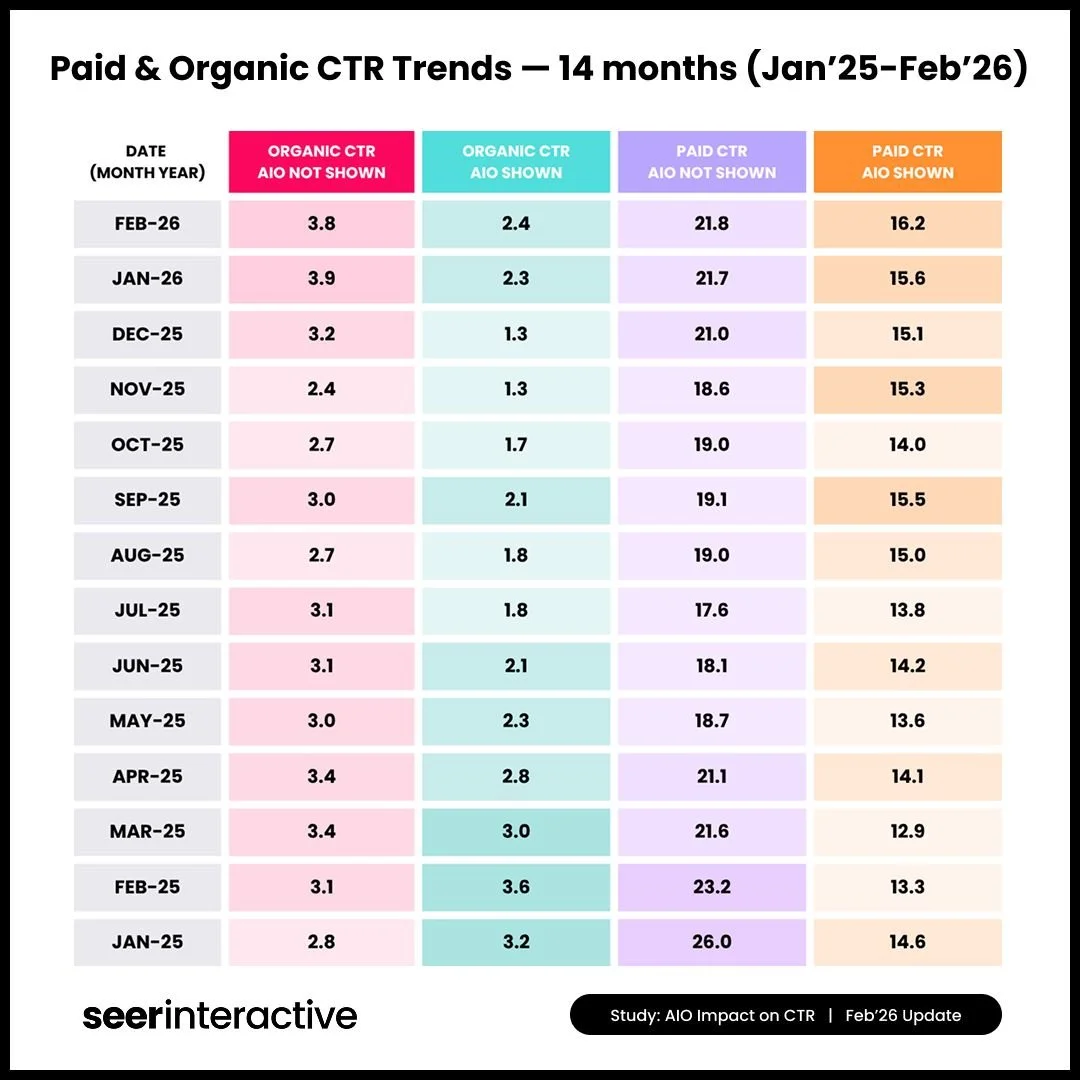
But what does this actually mean? Is this good news for SEO—or just a temporary behavioral adjustment?
The Context: CTR Decline with AI Overviews
When Google expanded AI Overviews, the impact was immediate: fewer clicks to websites.
Why? Because AI-generated answers began satisfying user intent directly within the search results page—reducing the need to click.
This ties directly into the rise ofzero-click searches
Throughout 2025, multiple studies confirmed that users were increasingly getting answers without leaving Google. For many brands, this meant:
Drops in organic traffic.
Reduced real visibility (even when rankings remained stable).
A shift in how SEO performance is measured.
This evolution is part of a broader transformation toward AI-driven search, where content doesn’t just compete for rankings—but for inclusion in AI-generated answers.
Why Is CTR Increasing Now?
This rebound isn’t random, it’s the result of several strategic shifts:
1. Improved AI Overview design
Google has refined how AI Overviews display sources. External links are now more visible and engaging.
This suggests Google is trying to balance:
Keeping users within its ecosystem.
Preserving value for publishers.
2. Increased user trust, but with verification behavior
As users grow more familiar with AI-generated answers, they’re also becoming more critical. Many now click through to verify information.
This is where brand authority and entity recognition become crucial, as explained inentity SEO and how brands rank in AI-driven search
3. Saturation of generic AI content
Another key factor: users are noticing repetitive, shallow AI-generated answers.
This is pushing them to seek deeper, more trustworthy sources—leading to more clicks.
This issue is explored in why generic AI content is quietly killing brand performance
4. Better optimization strategies for AI Overviews
SEO professionals are adapting. Content is now being structured specifically to appear in AI Overviews.
For example:
“ how to rank in AI Overviews with advanced strategies “AI SEO content structure for Google AI Overviews”
This leads to higher-quality, more relevant content, which naturally improves CTR.
The New Paradigm: From Ranking to Being Cited
One of the most important shifts reflected in this CTR increase is a change in SEO mindset.
Before:
The goal was ranking in the top 3
Now:
The goal is being cited by AI
This aligns with modern strategies like LLM SEO and how to design content for AI citations, and also withLLM-first content strategies designed for citations, not clicks
AI Overviews Aren’t Killing SEO, They’re Redefining It
It’s easy to fall into the narrative that “SEO is dying.” But the data tells a different story.
This CTR increase suggests:
Traffic isn’t disappearing—it’s being redistributed.
Users still click—but with higher intent.
Content quality matters more than ever.
This ties directly intohow AI is reshaping SEO opportunities for brands
The Role of Omnichannel SEO in This New Era
Search behavior is no longer confined to Google.
Today, users search across:
TikTok.
YouTube.
Reddit.
Quora.
Claude.
Perplexity.
ChatGPT.
Amazon.
Relying solely on traditional SEO is now a risk.
That’s why strategies likeOmnichannel SEO: ranking across Google, social platforms, and AI search are becoming essential, alongside broader frameworks likeSearch Everywhere Optimization
Multimodal Search and the Future of CTR
The CTR recovery is also linked to the rise of multimodal search.
Users now interact with:
Text.
Images.
Video.
Voice.
This changes how information is consumed, and how users decide to click.
Learn more inthe rise of multimodal search and its SEO impact, and its evolution towardhow to optimize for multimodal AI search in 2026
Not All Positive: Risks and Challenges
Despite improvements, challenges remain:
1. Ongoing volatility
Google continues testing AI Overviews—meaning trends could shift again quickly.
2. Dependence on AI interpretation
Brands are increasingly reliant on how AI models understand their content.
This creates risks likeAI misinterpretation and SEO errors
3. Increased competition for visibility
You’re no longer just competing with other websites—but with:
Featured snippets.
Aggregated content.
What Should Brands Do Now?
This CTR increase is an opportunity, but only for those who adapt.
✔️ Create deep, differentiated content.
✔️ Optimize for intent, not just keywords.
✔️ Build strong brand authority.
✔️ Integrate SEO with other channels.
✔️ Design content for AI-first indexing.
CTR Is Improving, But the Game Has Changed
The increase in CTR for AI Overview queries isn’t just good news—it’s a signal of adaptation.
SEO isn’t disappearing. It’s evolving into:
Smarter content.
Omnichannel strategies.
AI-driven optimization.
The brands that understand this shift won’t just recover traffic—they’ll dominate the future of search.
Win in the AI-Driven Search Era?
If you want your brand to not just survive—but grow—in a world dominated by AI Overviews, you need a strategy built for what’s next.
At Searches Everywhere we help brands build visibility across the entire search ecosystem:
AI Overview SEO
Omnichannel strategies
LLM-optimized content
Digital authority and branding
You can also accelerate your growth with ourgraphic design services Or mail us to: lauren@searcheseverywhere.com or seo@searcheseverywhere.com
The future of SEO is already here. The only question is: is your strategy ready for it?
FAQs
1. Are AI Overviews increasing or decreasing organic CTR?
AI Overviews initially reduced organic CTR, but recent data from early 2026 shows a recovery, with CTR rising from around 1.3% to 2.4% for queries that include AI-generated results.
2. Why did CTR drop when Google introduced AI Overviews?
CTR dropped because AI Overviews answer user queries directly on the search results page, reducing the need for users to click on external websites.
3. Why is organic CTR improving again in 2026?
CTR is improving due to better AI Overview design, increased user trust (and verification behavior), and higher-quality content optimized for AI visibility.
4. Does AI Overviews mean SEO is no longer important?
No. SEO is evolving, not disappearing. The focus is shifting from ranking to being cited in AI-generated responses.
5. How can I optimize my content for AI Overviews?
You should focus on structured, authoritative, intent-driven content that answers questions clearly and builds topical authority.
6. What is the biggest SEO change caused by AI search?
The biggest shift is from keyword-based ranking to entity-based visibility and AI citation within search experiences.
7. Will zero-click searches continue to grow?
Yes, but they are evolving. While some searches remain zero-click, others now drive more qualified clicks due to user verification behavior.
8. What role does branding play in AI-driven SEO?
Brand authority is critical. Strong brands are more likely to be trusted and cited by AI systems, improving visibility and CTR.
