
Does AI Help With Local SEO for Small Businesses? 2026 Guide
Yes, AI can help small businesses with local SEO by accelerating keyword research, review management, listing audits, content planning, and competitive analysis.
AI does not replace local SEO fundamentals. Google Business Profile accuracy, reviews, citations, service pages, local relevance, and real-world reputation still matter.
AI Overviews and conversational search create a second visibility layerwhere businesses compete to be recommended, not just ranked.
Small businesses can compete with larger brands by being more locally specific, especially through detailed service information, authentic reviews, neighborhood expertise, and clear answers to customer questions.
The best approach is human-led, AI-assisted local SEO:automate repetitive work while keeping strategy, accuracy, expertise, and customer experience human.
Does AI help with local SEO for small businesses?
Yes, but probably not in the way the hype makes it sound.
AI will not magically push a bakery, dentist, contractor, restaurant, or independent retailer into Google's Local Pack. What it can do is make the work behind strong local visibility significantly faster: identifying customer questions, analyzing reviews, spotting inconsistent listings, creating first drafts, comparing competitors, and finding hyperlocal opportunities a small team might otherwise miss.
At the same time, AI is changing the search experience itself.
Customers aren't only typing “plumber near me” anymore. They can ask ChatGPT, Gemini, Perplexity, or Google a much more specific question: “Who is a highly rated emergency plumber near me that works weekends and has experience with older homes?”
That favors businesses whose digital presence contains enough specific, credible information for search and AI systems to confidently understand them.
Search Quest's analysis of how AI is changing local search in 2026 makes an important distinction: the fundamentals—Google Business Profiles, reviews, citations, and local relevance—haven't disappeared. AI is amplifying them.
That means small businesses don't need to abandon local SEO. They need to make it more efficient, specific, and AI-readable.
How Does AI Help Small Businesses With Local SEO?
AI makes local keyword research much faster
Traditional local keyword research can become repetitive quickly. You start with “dentist Denver,” then move into services, neighborhoods, problems, questions, and modifiers.
AI can accelerate that expansion.
A local dentist, for example, might discover opportunities around:
Emergency dentist open Saturday
Dentist for nervous patients
Same-day broken tooth repair
Family dentist near a specific neighborhood
Dentist accepting new patients
The advantage isn't simply generating more keywords. AI can help cluster those searches around intent and identify which questions deserve service pages, FAQs, Google Business Profile content, or educational articles.
This matters because search behavior is increasingly conversational. TTOY Digital's analysis of how AI search is changing local SEO for small businesses notes the shift from short keyword strings toward natural, question-based searches.
That aligns closely with a broader Search Everywhere approach to ranking across Google, social platforms, and AI search: understand the intent first, then make the business discoverable wherever that intent appears.
Expert Insight:AI is most useful for local keyword research when it expands human insight instead of replacing it. A tool can suggest neighborhood questions, but the business owner still knows which problems customers actually call about, which services are profitable, and which local details matter.
Can AI Improve Google Business Profile and Reputation Management?
Absolutely. This may be one of AI's most practical benefits for smaller businesses.
A strong Google Business Profile still gives Google critical information about what a business offers, where it operates, when it's available, and how customers evaluate it. AI can reduce the workload required to keep that ecosystem active.
Use AI to support (but not automate away) review responses
AI can help draft responses to positive and negative reviews, summarize recurring customer feedback, identify sentiment patterns, and flag reviews that need immediate human attention.
That is useful for a small business receiving dozens of reviews but lacking a dedicated marketing employee.
The important distinction is that AI should draft, not impersonate.
“Thank you for your feedback!” repeated 100 times adds very little value. A response referencing the service, customer experience, or specific compliment sounds more authentic and reinforces contextual information about the business.
Search Quest similarly recommends using AI-generated review responses as drafts that humans personalize before publishing.
Reviews also increasingly contribute to the broader trust profile that AI tools can draw from when comparing local providers.
This connects with our analysis of how AI search is changing local SEO and personal branding, where visibility depends on more than the content sitting on your own website.
Can AI Make Local Listings and Citations Easier to Manage?
Yes, and this is where automation can save substantial time.
A small business may appear across Google, Apple Maps, Bing, Yelp, Facebook, industry directories, chambers of commerce, review platforms, and dozens of secondary databases.
If the business name, address, phone number, website, opening hours, or service information differ from one source to another, both customers and machines receive conflicting signals.
AI-assisted local SEO platforms can help identify those inconsistencies, prioritize corrections, and monitor listings after updates.
Search Quest specifically highlights AI-assisted citation and NAP management as an efficiency gain because tools can identify inconsistent business information across large numbers of directories without requiring a manual audit.
For AI-powered discovery, this consistency becomes even more important. Search systems need confidence that the dentist mentioned on a website, Google profile, directory, and review platform is the same entity.
Our guide to entity SEO and how AI systems understand brands explains why that consistency matters beyond conventional rankings.
Expert Insight:Local citations are no longer just links or directory placements. Collectively, they help verify an entity. The more consistently your business is described across trusted sources, the easier it becomes for search and AI systems to understand who you are, where you operate, and what you do.
How AI Overviews Are Showing Up for Local Searches?
AI Overviews introduce another layer between a user's question and traditional organic results.
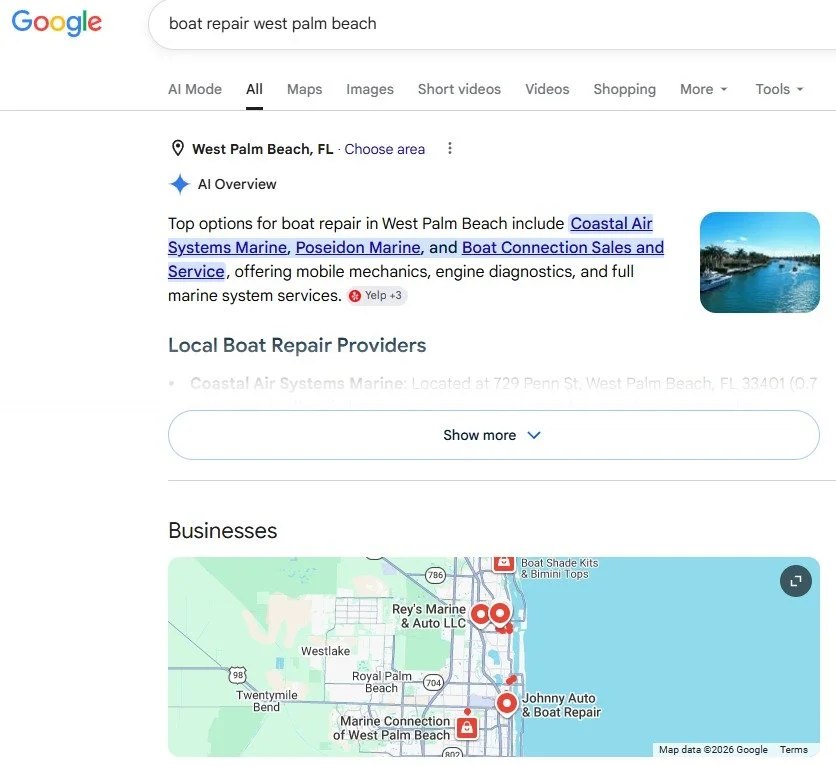
For some detailed local queries, Google can synthesize information before the searcher reaches individual webpages. Search Quest notes that AI Overviews can combine information from websites, Google Business Profiles, reviews, and other local signals when answering complex local questions.
This changes the competitive question.
It is no longer only:
“Does my business rank?”
It is also:
“Does Google have enough trustworthy information to include my business in the answer?”
TTOY Digital similarly observes that businesses are increasingly competing for inclusion within AI-generated responses, making authority, trust, clear information architecture, and genuinely useful content more valuable.
The practical response is not to create separate “AI content.” Instead, improve the information AI systems have available:
Clearly explain every core service
Maintain complete and accurate business information
Publish FAQs using real customer questions
Earn detailed customer reviews
Add genuine local expertise
Use structured data where appropriate
Keep contact and location information consistent
Our guide to ranking in Google AI Overviews covers the same principle at a broader SEO level: make your information easy to identify, understand, verify, and extract.
Does AI Give Small Businesses an Advantage Over Large Competitors?
Potentially, especially for highly specific local searches.
A national chain may have dramatically more backlinks and brand authority. But the independent business down the road may have something harder to manufacture at scale: precise local knowledge.
The local SEO community is divided on whether AI inherently levels the playing field, but discussion around the topic highlights a meaningful possibility: detailed reviews, strong Google Business Profile information, and highly specific service pages can help smaller companies compete when the query demands local nuance rather than generic brand authority.
Imagine the search:
“Where can I get gluten-free pizza that delivers downtown after 10 p.m.?”
A large chain's generic city page may contain little information answering that exact need. A small restaurant with accurate hours, detailed menu information, neighborhood references, strong reviews, and FAQs may provide a much clearer answer.
That is the opportunity. AI search can reward specificity.
A broader analysis of small-business discovery also notes that detailed service descriptions, authentic reviews, FAQs, directories, community conversations, and local expertise can help AI systems confidently understand and reference smaller businesses.
What Should Small Businesses Not Use AI For?
AI should not become a shortcut for producing dozens of nearly identical location pages.
Nor should it invent customer stories, fake expertise, fabricate statistics, or mass-produce generic reviews and responses.
Search Quest specifically warns against mass-generating location pages by simply swapping city names and recommends human review plus genuine local expertise when AI assists content production.
The same principle appears throughout modern AI search guidance: useful information wins over automated volume.
If a business wants to create content for five neighborhoods, each page should contain something genuinely specific—services offered there, landmarks, customer questions, local conditions, real projects, photos, testimonials, or other meaningful context.
That's also why generic AI content can quietly damage brand performance. Scale without differentiation creates more pages, not necessarily more authority.
Expert Insight: The winning formula for small businesses is not “AI-generated local SEO.” It is AI-assisted local expertise. Let the machine accelerate research and execution; let real business experience create the reasons customers—and AI systems—should trust the result.
FAQs
Does AI actually help local SEO for small businesses?
Yes. AI can make local SEO more efficient by accelerating keyword research, drafting review responses, analyzing competitors, auditing listings, generating content ideas, and identifying customer questions. However, it does not replace fundamentals such as an optimized Google Business Profile, accurate listings, strong reviews, useful service pages, and real local authority.
Can a small business use AI for SEO without hiring an agency?
Yes. Smaller businesses can use AI tools for research, content planning, review-response drafts, listing analysis, and reporting. The challenge comes when multiple locations, technical issues, competitive markets, content strategy, structured data, or AI visibility tracking require deeper expertise. AI reduces labor, but it does not automatically create a strategy.
Will AI replace Google Business Profile optimization?
No. Google Business Profile remains a critical source of business information for local discovery. Accurate categories, services, hours, photos, reviews, locations, and contact information help both users and search systems understand the business. AI makes maintaining that information easier; it does not make the profile unnecessary.
How can a local business appear in AI-generated answers?
Start by making your business exceptionally easy to understand and verify. Create detailed service pages, answer specific customer questions, maintain consistent business information, collect authentic reviews, strengthen local citations, publish original local content, and build third-party mentions. AI systems need reliable evidence before confidently recommending a business.
Is AI-generated content safe for local SEO?
AI-assisted content can be useful when humans review it for accuracy, originality, and local relevance. Problems arise when businesses mass-publish thin pages, fake local expertise, or create near-duplicate location content. Use AI to accelerate research and drafting, then add real examples, local knowledge, customer insights, and editorial judgment.
How should small businesses measure AI local SEO success?
Continue tracking local rankings, Google Business Profile actions, calls, leads, organic traffic, reviews, and conversions, but add newer indicators such as AI citations, brand mentions, AI referral traffic, and AI Share of Voice. Our guide tomeasuring AI SEO success and our breakdown of AI Share of Voice measurement tools explain how to expand traditional reporting.
Ready to Make AI Work for Your Local Business?
AI does help with local SEO for small businesses, but only when it supports a strong foundation.
At Searches Everywhere, we help businesses build visibility across traditional search, Maps, AI Overviews, conversational search, and the wider discovery ecosystem through Search Everywhere Optimization services.
We can also strengthen the brand signals behind that visibility withbranding strategy services, close immediate visibility gaps throughpaid advertising, and build cohesive digital assets through ourgraphic design services.
If you want to see practical ways to start using AI immediately, explore our guide tofour ways AI can help with local SEO.
To request a customized strategy for your business, contact lauren@searcheseverywhere.com or seo@searcheseverywhere.com
